The IETS laptop cooler significantly reduces laptop temperatures by 10-15°C, with some users reporting drops of 22-24°C under full load, preventing thermal throttling and extending component lifespan. Unlike generic cooling pads, IETS models like the GT500 and GT600 use a powerful turbofan and an airtight sealing system to deliver targeted, pressurized airflow directly into a laptop’s intake vents, ensuring maximum heat dissipation.
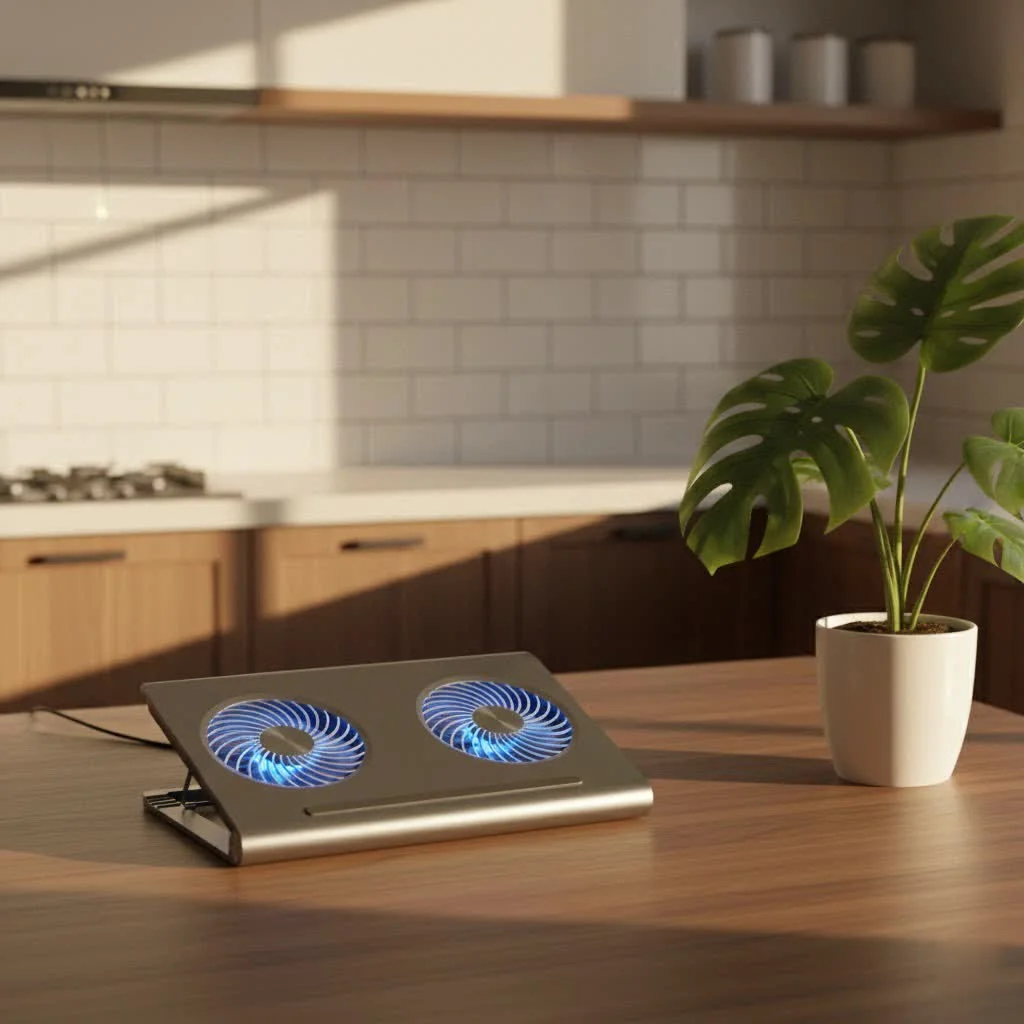
The Hidden Enemy: Understanding Laptop Overheating
Laptops often overheat due to their compact design, which packs high-performance components like CPUs and GPUs into tight spaces. Unlike desktop PCs with ample cooling, laptops struggle to dissipate the heat generated during intensive tasks, leading to performance issues.
The primary defense against overheating is “thermal throttling,” where the laptop’s internal systems reduce CPU and GPU clock speeds to prevent damage. This results in sudden drops in frame rates, slow rendering, and sluggish performance. Prolonged high temperatures also shorten the lifespan of critical components like the motherboard, battery, and storage drives. An overheated laptop is uncomfortable to use, especially on one’s lap.
Internally, laptops use thermal paste, cold plates, heat pipes, and small, high-speed fans to move heat. While these systems are sophisticated, they often struggle under sustained heavy loads, particularly as dust accumulates and restricts airflow over time.
Beyond the Breeze: What Makes IETS Laptop Coolers Stand Out
The IETS laptop cooler series, including models like the GT500 and GT600, stands out from other cooling pads due to its unique engineering philosophy focused on targeted, pressurized cooling rather than generic airflow.
The Turbo-Fan Advantage: Powering Through the Heat
IETS coolers utilize a single, industrial-grade turbofan instead of multiple smaller fans. For example, the IETS GT500 and GT500 V2 feature fans spinning up to 5000 RPM, while the GT600 series uses a slightly larger fan optimized for airflow. This powerful fan creates a high-pressure zone, delivering a concentrated and forceful blast of cool air directly into the laptop’s cooling system, creating a controlled, high-volume airflow pathway.
The Airtight Seal: Precision Cooling Where It Matters
A key innovative feature of the IETS laptop cooler is its proprietary magnetic or sealed foam gasket system. These adjustable foam strips create an airtight chamber between the cooler and the laptop’s underside, preventing air from escaping. This forces nearly all the cool air from the turbofan directly into the laptop’s intake vents.
As Dr. Anya Sharma, Lead Thermal Architect at Tselk.com, explains, “What sets the IETS design apart is its commitment to direct, forced airflow. That sealed foam gasket isn’t just a gimmick; it’s a critical engineering detail that ensures nearly every cubic foot of air moved by that powerful fan goes exactly where it needs to go – into your laptop’s intake.” This focused approach ensures maximum heat dissipation, making the IETS system exceptionally effective, especially for laptops with bottom or rear-facing intake vents.
Built to Last: Durability and Smart Features
|
Our Picks for the Best Laptop Cooler in 2026
As an Amazon Associate I earn from qualifying purchases.
|
||
| Num | Product | Action |
|---|---|---|
| 1 | Razer Laptop Cooling Pad: Adaptive Smart - Intelligent Fan Control - Airtight Pressure Chamber - Fits Most Laptops & Macbooks 14” to 18\" - Preset & Custom Fan Curves - 3 Port USB Type A - Chroma RGB |

|
| 2 | KeiBn Laptop Cooling Pad, Gaming Laptop Cooler 2 Fans for 10-15.6 Inch Laptops, 5 Height Stands, 2 USB Ports (S039) |
|
| 3 | AICHESON Laptop Cooling Pad 5 Fans Up to 17.3 Inch Heavy Notebook Cooler, Blue LED Lights, 2 USB Ports, S035, Blue-5fans |
|
| 4 | havit HV-F2056 15.6\"-17\" Laptop Cooler Cooling Pad - Slim Portable USB Powered (3 Fans), Black/Blue |
|
| 5 | llano V12 RGB Laptop Cooling Pad, Gaming Laptop Cooler with 5.5 Inch Powerful Turbofan, Fast Cooling Laptop 15.6-21in, Adjustable Speed, Touch Control, LCD Screen, Black (RGB) |
|
| 6 | llano V12 Laptop Cooling Pad, Gaming Laptop Cooler Stand with 5.5inch Powerful Turbo Fan, Adjustable Speed, Touch Control, 3-Port USB A, for Fast Cooling Laptop 15.6-19in, Black (No RGB) |
|
| 7 | Kootek Laptop Cooling Pad, Laptop Cooler with 5 Quiet Fans for 12\"-17\" Computer PC Notebook Gaming Laptop Fan, Height Adjustable Laptop Cooling Stand Laptop Accessories, Blue |
|
| 8 | ChillCore Laptop Cooling Pad, RGB Lights Laptop Cooler 9 Fans for 15.6-19.3 Inch Laptops, Gaming Laptop Fan Cooling Pad with 8 Height Stands, 2 USB Ports - A21 Blue |
|
| 9 | Laptop Cooling Pad, Gaming Laptop Cooler for 13-19 Inch Laptops, RGB Lights Laptop Fan Cooling Pad with 3 Height Adjustable and 3 USB Ports, 4.72 Inch Large Turbo Fan, Max 3500RPM |
|
| 10 | Laptop Cooling Pad, Laptop Cooler 6 Quiet Fans for 12\"-17\" Laptops, Gaming Laptop Fan Cooling Pad with 5 Height Adjustable, Slim Portable USB Powered, 2 USB Ports & Phone Holder |
|
IETS coolers are designed for durability and user convenience, typically featuring solid metal or sturdy plastic construction. They include adjustable height settings and anti-slip foot pads for stability and ergonomic use.
Many models, such as the GT500, incorporate a built-in dust filter to prevent debris from entering the laptop’s internal components, extending its lifespan and reducing cleaning needs. Adjustable fan speed controls allow users to balance cooling intensity with noise levels. Some IETS laptop cooler models also include integrated USB hubs, providing extra ports and compensating for the cooler’s external power requirement.
Real-World Impact: What Temperatures Can You Expect with an IETS Cooler?
Users consistently report significant temperature reductions with an IETS laptop cooler, often seeing CPU and GPU temperatures drop by 10-15°C, with some benchmarks showing reductions of 22-24°C from stock temperatures under full load.
This substantial cooling capacity prevents thermal throttling, allowing laptops to maintain higher clock speeds for longer. For gamers, this means smoother gameplay and more consistent frame rates (FPS). For professionals, it translates to faster video rendering, more responsive multitasking, and increased productivity. IETS coolers are particularly beneficial for high-performance gaming laptops and other resource-intensive machines, and the sealed foam helps even with less ideal vent placements.
Weighing the Options: Pros and Cons of IETS Laptop Coolers
An IETS laptop cooler offers distinct advantages and a few considerations.
The Upsides:
- Exceptional Cooling Performance: Provides unmatched temperature drops for both CPU and GPU, crucial for high-performance tasks.
- Effective Thermal Throttling Prevention: Maintains peak laptop performance, preventing degradation and boosting FPS.
- Enhanced Laptop Lifespan: Reduces thermal stress on components, contributing to a longer, healthier device life.
- Integrated Dust Filter: Helps keep laptop internals cleaner, reducing maintenance and improving long-term thermal efficiency.
- Robust Build Quality: Constructed for heavy use, offering stability and durability.
- Targeted Airflow: The sealed foam design ensures cool air reaches precisely where it’s needed most.
The Considerations:
- Noise at Max Speed: At full throttle, the industrial-grade turbofan can be loud (e.g., 59.2 dB for GT500, 65 dB for GT500 V2), comparable to a small jet engine. However, infinitely variable speed control allows for quieter operation during less intensive tasks.
- Bulkiness and Portability: IETS coolers are larger and heavier than typical cooling pads, making them less ideal for frequent travel and more suited for a permanent desktop setup.
- External Power Dependency: Requires an external wall power supply for maximum performance, meaning an extra cable and outlet are needed.
- Foam Pad Longevity: Some users note that the foam pad may shift or degrade over very long periods, potentially affecting the airtight seal, which is a minor point to monitor.
Maximizing Your Cooling Strategy: Tips for Optimal Performance
Even the best IETS laptop cooler performs better with good practices.
- Proper Placement: Ensure your laptop is correctly seated on the cooler, aligning its intake vents with the cooler’s airflow path. Adjust the foam gaskets to create the tightest possible seal.
- Regular Cleaning: Regularly clean the dust filter on your IETS cooler. Also, clean your laptop’s external vents with compressed air to prevent internal dust buildup, which can restrict airflow.
- Check Thermal Paste: For older laptops, consider professional replacement of thermal paste on your CPU and GPU, as dried-out paste can significantly hinder heat transfer.
- Environmental Factors: A cooler room environment will always yield better results. Avoid placing your laptop in direct sunlight or poorly ventilated areas.
Frequently Asked Questions About IETS Laptop Coolers
Q: Are IETS laptop coolers worth the investment?
A: Yes, for users experiencing thermal throttling, performance issues, or seeking to extend their laptop’s lifespan, an IETS laptop cooler is a worthwhile investment. Its unique design provides significant temperature reductions and stable performance beyond generic cooling pads.
Q: How loud is an IETS cooler at full speed?
A: At maximum speed, an IETS laptop cooler can reach noise levels up to 65 dB, which is louder than a typical conversation. However, adjustable fan speed allows for quieter operation during less demanding tasks, and many users find the noise tolerable, especially with headphones.
Q: Can an IETS cooler damage my laptop?
A: No, an IETS cooler is designed to improve your laptop’s thermal environment and prevent damage from overheating. By reducing internal temperatures, it helps extend the lifespan of your components rather than harming them.
Q: What’s the difference between the IETS GT500 and GT600?
A: Both the GT500 and GT600 series are high-performance IETS laptop cooler models. The GT600 is often considered a successor, potentially featuring a larger fan (though sometimes with slightly lower RPM than the GT500 V2’s 5000 RPM fan) and improved foam density for a better seal. Both offer exceptional cooling.
Q: How do I clean my IETS laptop cooler?
A: Most IETS coolers have an accessible, often washable, dust filter that should be cleaned regularly. For the fan blades and interior, use compressed air to remove accumulated dust. Regular filter cleaning is crucial for maintaining optimal airflow.
Conclusion: Keep Your Cool, improve your Performance
Managing heat is crucial for unlocking and maintaining a laptop’s full potential. The IETS laptop cooler is a serious thermal engineering solution, not just an accessory. Its powerful turbofan and intelligent airtight sealing system deliver directed cooling unmatched by many traditional pads. While it has considerations like noise and size, the performance benefits—including dramatic temperature drops, stable high-frame-rate gaming, and swift content creation—are undeniable. If thermal throttling is hindering your laptop, an IETS laptop cooler offers a confident step towards a cooler, faster, and more reliable computing experience.
Frequently Asked Questions
Are IETS laptop coolers a worthwhile investment for performance?
Yes, an IETS laptop cooler is a worthwhile investment for users experiencing thermal throttling or performance issues. Its unique design provides significant temperature reductions of 10-15u00b0C and stable performance, offering tangible benefits beyond generic cooling pads.
What are the typical noise levels of an IETS cooler at maximum speed?
At maximum speed, an IETS laptop cooler can be quite loud, with noise levels reaching up to 65 dB, which is louder than a typical conversation. However, the adjustable fan speed allows users to reduce noise for less demanding tasks, and many find the noise tolerable when wearing headphones.
Can using an IETS cooler cause damage to my laptop components?
No, an IETS cooler is specifically designed to improve your laptop's thermal environment and prevent damage caused by overheating. By reducing internal temperatures, it helps extend the lifespan of your components rather than harming them.
What are the main differences between the IETS GT500 and GT600 models?
Both the GT500 and GT600 series are high-performance IETS laptop cooler models. The GT600 is often considered a successor, potentially featuring a larger fan (though sometimes with slightly lower RPM than the GT500 V2's 5000 RPM fan) and improved foam density for an even better seal. Both offer exceptional cooling performance.
What is the recommended method for cleaning an IETS laptop cooler?
Most IETS coolers include an accessible dust filter that can be removed and cleaned, often washable. For the fan blades and interior, use compressed air to dislodge any accumulated dust. Regular cleaning of the filter is key to maintaining optimal airflow and efficiency.
Maximizing Your IETS Laptop Cooler Performance
Follow these steps to ensure your IETS laptop cooler provides optimal cooling and extends your laptop's lifespan.
Correctly seat your laptop on the cooler, aligning its intake vents with the cooler's airflow path. Adjust the foam gaskets to create the tightest possible seal, preventing air from escaping and ensuring direct airflow.
Regularly clean the dust filter on your IETS cooler, as it can be removed and often washed. Additionally, make it a habit to clean your laptop's external vents with compressed air to prevent internal dust buildup, which severely restricts airflow.
For older laptops, consider having the thermal paste on your CPU and GPU replaced by a professional. Dried-out thermal paste can significantly hinder heat transfer, reducing the effectiveness of any cooling solution.
While your IETS cooler will battle heat effectively, a cooler room environment will always yield better results. Avoid placing your laptop in direct sunlight or in poorly ventilated areas to further enhance cooling efficiency.
Get our weekly buyer guide
Practical specs, not advice. Unsubscribe anytime.
I was skeptical about how much a cooler could really do, but the IETS GT500 is no joke. My gaming laptop used to hit crazy temps, especially during long sessions, and I’d notice a definite slowdown. Now, with the airtight sealing system, my CPU and GPU temps are consistently 15-20°C lower. It’s made a huge difference in preventing thermal throttling and keeping my frame rates stable.
I got the IETS GT600 hoping for those huge temperature drops, but I’m only seeing about a 7-8°C reduction on my work laptop. It’s better than nothing, and it does feel cooler to the touch, but I was expecting more based on some of the claims of 22-24°C drops. Maybe my laptop’s intake vents aren’t perfectly aligned with the cooler’s design. It’s decent, but not a total game-changer for me.
This IETS cooler really works! I’ve got an older MacBook Pro that would get scorching hot just doing video editing, and I was constantly worried about damaging it. The turbofan on this thing is powerful, and I’ve seen my temps drop by about 10-12°C, which is exactly what I needed. My only minor complaint is that it can be a bit noisy when it’s really cranked up, but the performance boost is worth it.
Seriously impressed with the IETS cooler. I used to think all cooling pads were basically the same, just glorified fans. But the targeted, pressurized airflow from this unit is on another level. My laptop’s performance during intense gaming sessions has improved dramatically, and I’m no longer worried about my components wearing out prematurely. Best investment for my setup in a long time.